Genealogical Community: 900+ DNA Communities Build on One Million Matches
New free Genomelink feature: find groups of DNA matches who share the same family roots. 900+ communities with maps, anchor ancestors and popular records.
Today we're launching a new feature called Genealogical Community. It helps you find groups of DNA matches who likely share the same family roots — the same region, the same migration story — and shows you what their family trees say about those roots.
We're launching with 900+ curated communities, built on our network of more than one million Genomelink users. That number will keep growing.
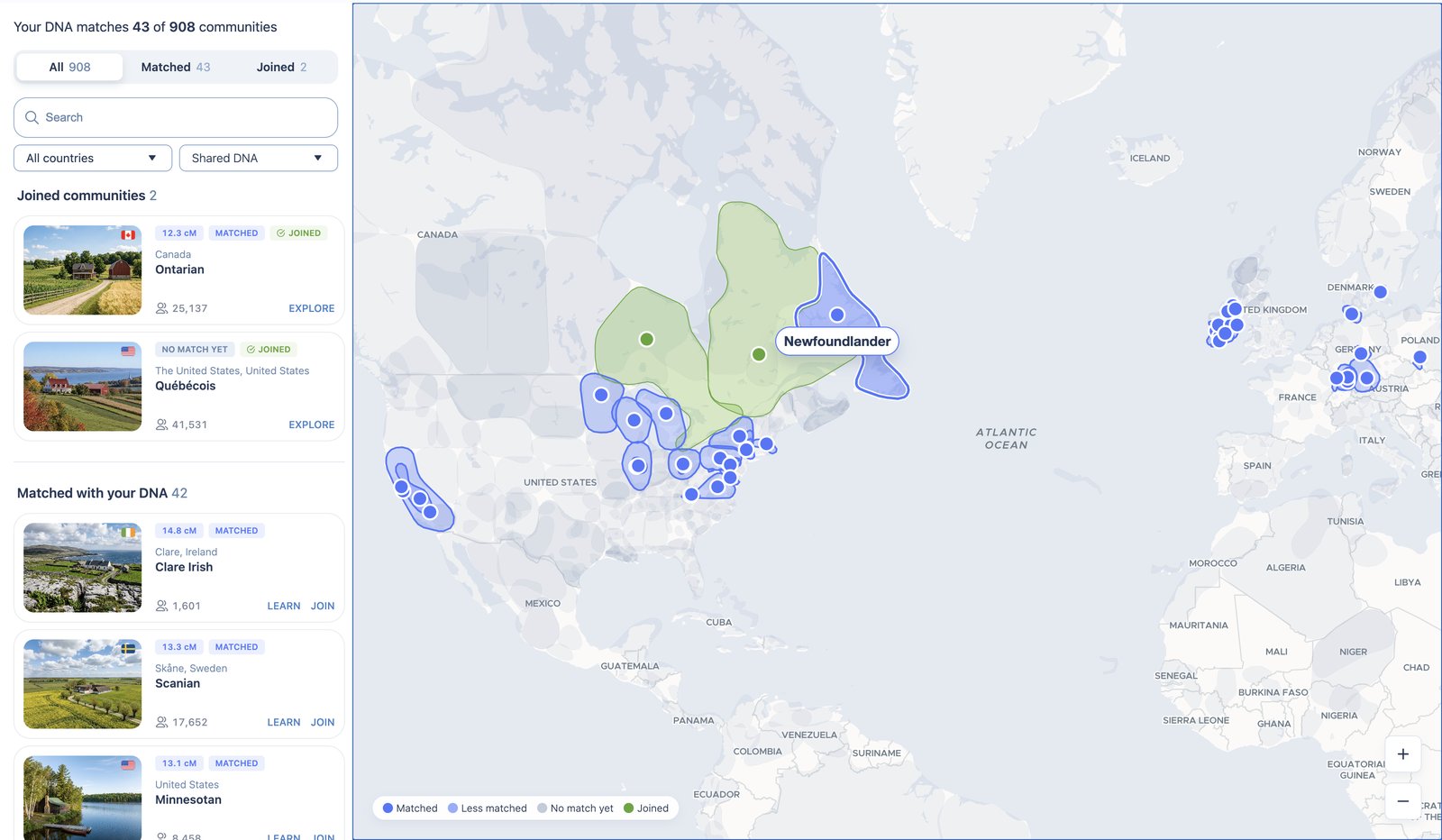
Your communities: the ones your DNA matched, and the ones you joined yourself. This account matched 43 of 908.
Why we built it
If you've done any genetic genealogy, you know the two main tools.
Ethnicity estimate compares your DNA against reference populations and gives you percentages by region. It's a great starting point, and a nice way to sanity-check your research. But it's hard to turn "32% Irish" into something you can actually use in your family tree.
DNA matches are the real workhorse. You compare your DNA one person at a time, across thousands of people, and trace shared ancestors through family trees. It works — but it depends on how big the network is and whether your relatives have tested.
We kept asking: can we build something in between? Something that gives more people a real insight about their roots, and still stays useful for actual research?
Genealogical Community is our answer.
How it works
It's free for every Genomelink user, just like DNA Match. We want as many people in the network as possible, because every new member makes it more useful for everyone else.
To get started, create your DNA Match profile and import your family tree (GEDCOM). The tree is what makes the insights specific, so don't skip it.
Then give us some time. For new users, matching can take up to 24 hours because we're running your DNA against everyone in the DNA Match network. We'll email you when your results are ready.
Your communities
The first thing you'll see is a map and a list of the communities you matched with. Most people will see 5 to 10. Some will see over 100. A few will see only one or two — that's a limit of our network size today, not a sign something went wrong.
This is not an ethnicity estimate. It works the other way around.
Ethnicity estimate is top-down: it starts with broad regional breakdowns and tries to go deeper. Genealogical Community is bottom-up. We find clusters of DNA matches who likely share the same geographic roots, identify a group of founder matches for each community, and measure how much DNA (in cM) you share with that founder group. We only show you communities where we see a real, genealogically meaningful signal.
That means it's not complete by design. It's limited to what our DNA match network covers today — and it gets better as the network grows.
Join communities yourself
We also did something a little different. If you know your family comes from somewhere and we haven't matched you to it yet, you can browse all 900+ communities and join the ones you think fit.
That helps in two ways. We learn from it and keep improving the matching, and when the DNA signal to that community shows up as the network grows, we'll notify you.
What you get for each community
Whether you matched or joined, every community comes with insights built from real family tree data. Here's what's there at launch. We'll keep adding more.
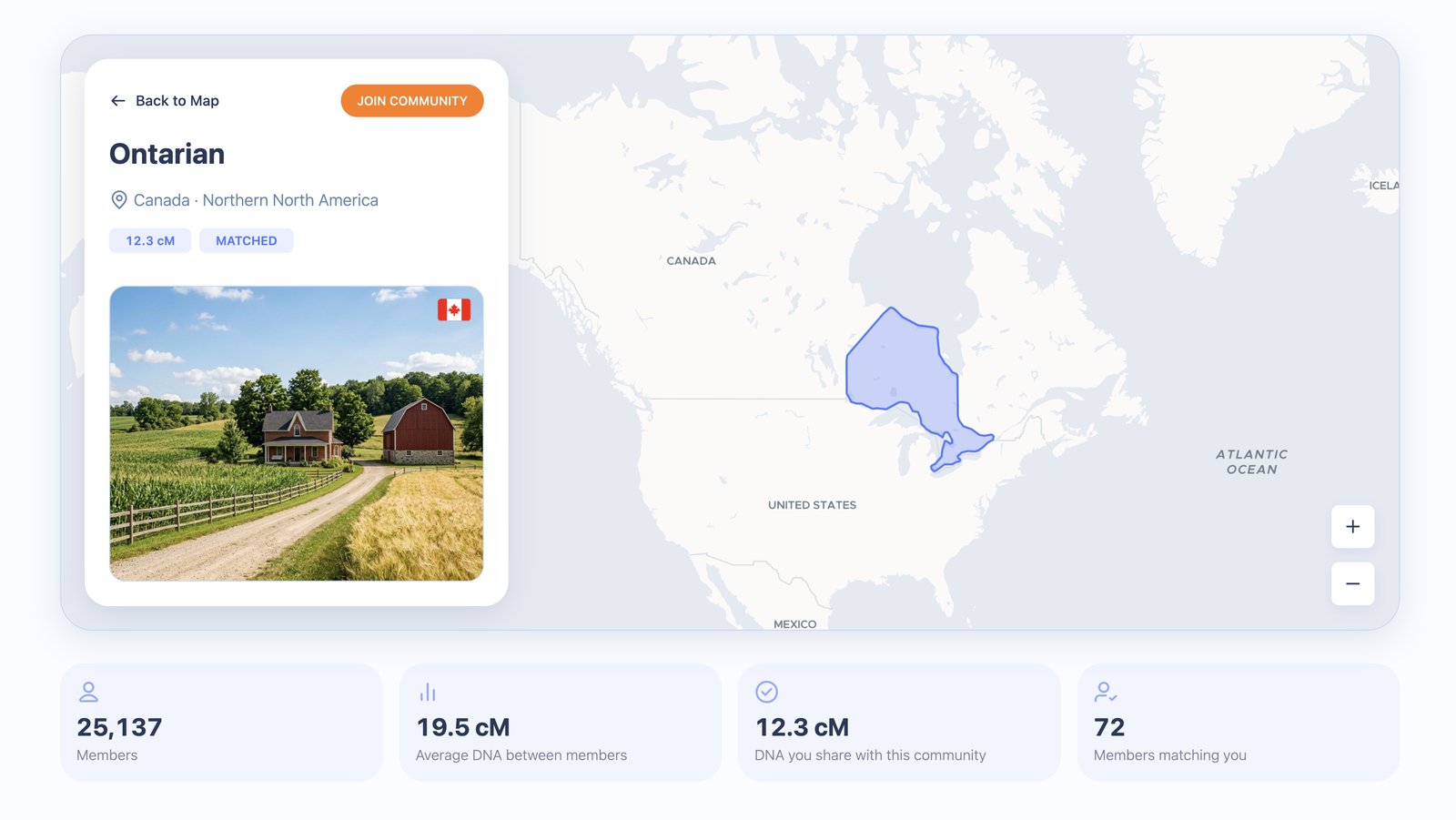
Ontarian community: members, average DNA between members, the DNA you share with the community, and how many members are on your match list.
Your matching score
At the top of every community page you'll see four numbers. Using the Ontarian community as an example:
25,137 members — how many people in our network belong to this community.
19.5 cM average DNA between members — how closely members are related to each other, on average. Higher means a tighter-knit community.
12.3 cM DNA you share with this community — your score. This is the DNA you share with the community's founder matches, and it's what decides whether you're a match.
72 members matching you — how many people in this community are also on your DNA match list.
Your DNA matches in this community
These are your DNA matches who are also part of the community. Genetically, they're more likely to share the same family roots as you — which can help you figure out which matches belong to which branch of your tree.
You can also compare your tree directly against a match's tree with our new Tree Match feature. Check matches one at a time, or hit "Bulk Tree Match" to look for common ancestors across many matches and tree databases at once.
One note: at launch, Bulk Tree Match searches our whole tree database, not just your community members. We plan to add a filter by community later.
Community insights
We aggregate genealogical data across each community. It's broad enough that no individual can be identified, but specific enough to tell you something real about the community and its roots. Let me use the Québécois community as the example for all three views below.
Where the community is today
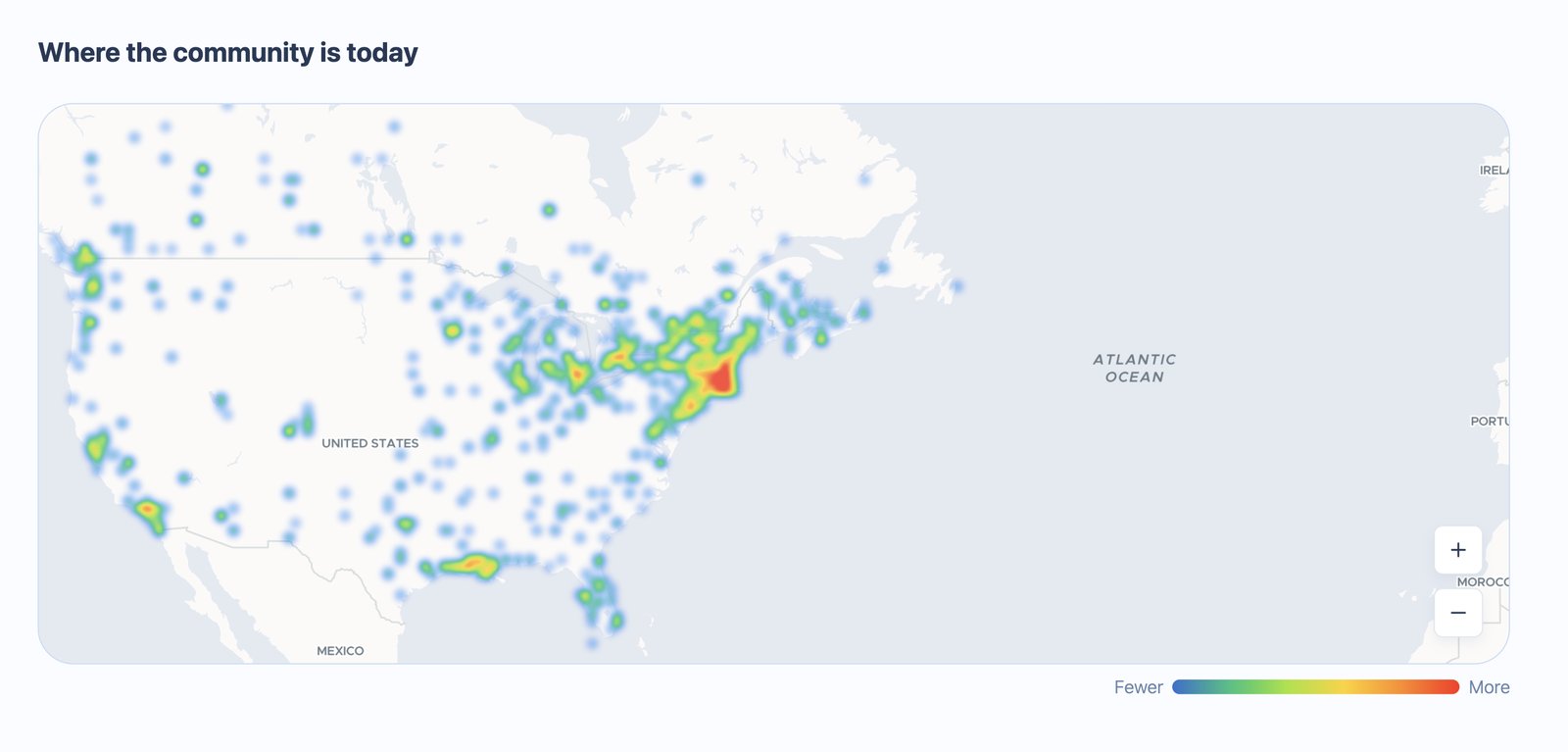
A heat map of where community members live now, based on the birthplace they entered in their DNA Match profile. Usually this lines up with the community's geography. Sometimes it doesn't, and that's where it gets interesting — when people with the same roots have spread far from where they started.
For Québécois, the hottest spot is New England, not Quebec. That's the story of the hundreds of thousands of French Canadians who moved south to work in the mill towns in the late 1800s. You can also see smaller clusters in Louisiana, Florida, and along the West Coast.
Where Québécois community members live today. The hottest spot is New England, not Quebec.
Where anchor ancestors are from
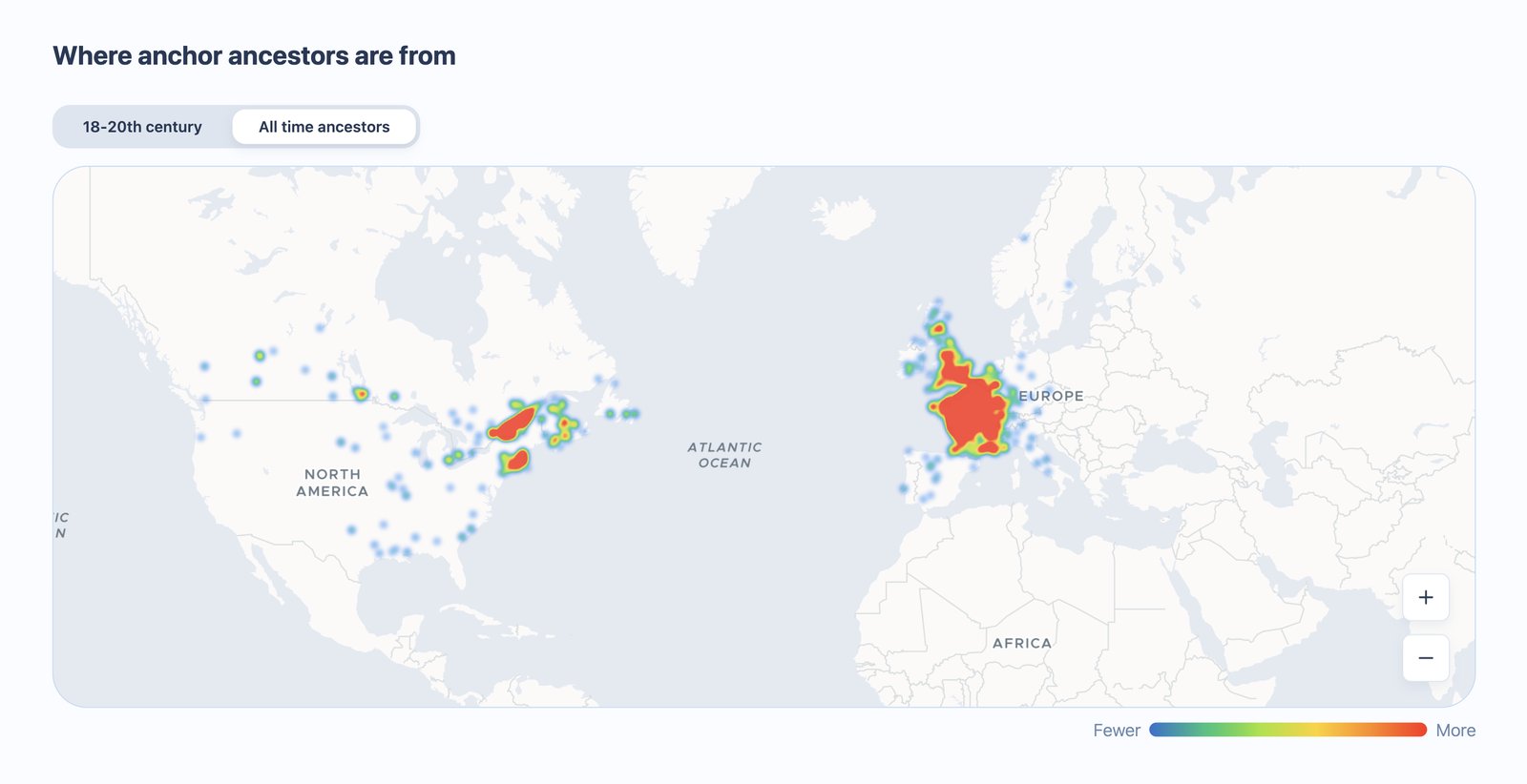
This is my favorite part. Because people join with their family trees, we can analyze where community members' anchor ancestors came from — and where their ancestors came from. You can switch between the 18th–20th century and all-time views.
We know from history that most Quebec families trace back to a few thousand French settlers who arrived in New France in the 1600s and 1700s. The all-time view confirms it: the map lights up over Quebec and the St. Lawrence valley on one side of the Atlantic, and over northwestern France on the other.
Where Québécois members’ anchor ancestors came from, all-time view: the St. Lawrence valley on one side of the Atlantic, northwestern France on the other.
Popular records
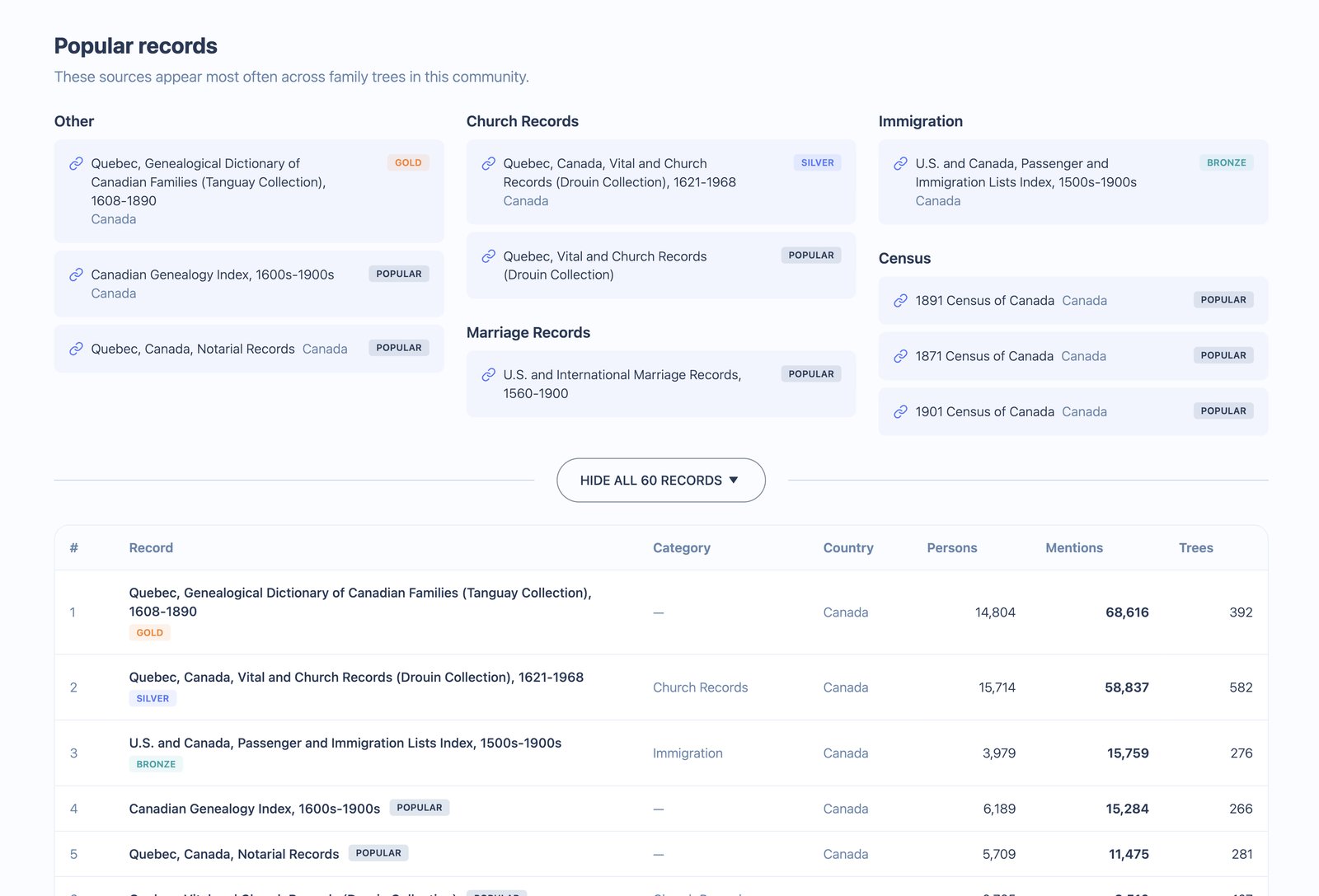
We look at which genealogy records community members used to source their anchor ancestors, and rank them. For Québécois, the top three are the Tanguay Collection (Genealogical Dictionary of Canadian Families, 1608–1890), the Drouin Collection (Quebec Vital and Church Records, 1621–1968), and the U.S. and Canada Passenger and Immigration Lists Index. Right behind them come Quebec notarial records and the 1871, 1891 and 1901 Canadian censuses.
Every community shows a completely different list, and it's a quick way to spot record sources you haven't searched yet.
The records Québécois members cite most for their anchor ancestors: Tanguay, Drouin, and the U.S. and Canada passenger lists.
One more thing: these insights are available for every community, including ones we haven't matched you to yet. Think of it as a genealogy resource you can browse across communities. And when you join one, that flags us to re-run matching for the whole network.
Help us make it better
Genealogical Community is free for all Genomelink and YourRoots users. We put a lot into building it. If you find it useful, the best thing you can do is spread the word — especially to genealogy groups focused on a specific region or family line. Every person who joins improves the matching for everyone.
This is a product that should grow with its community. If you have ideas for how to analyze community data, or insights you'd like to see, email me directly at tomo@genomelink.io. I read every message.
Tomo founded Genomelink in 2017 in San Francisco and has over a decade of experience in consumer and medical genomics. Before Genomelink, he was a business producer in the genomics business group at M3, Inc., where he led the building of a precision medicine network in Japan. Genomelink has been part of Illumina Accelerator, Berkeley SkyDeck (UC Berkeley), StartX (Stanford), and Y Combinator (S21). He tests DNA upload sites, genealogy tools, and ancestry reports with his own raw data file and writes up what he finds.
Get the most value from your DNA test results
Have you got DNA tested from Ancestry, 23andMe, or MyHeritage? Get free DNA analysis on Ancestry & Traits. Find more DNA matches & family trees.
Unearth your ancestral roots with genealogy DNA kits. Learn how collection kits, autosomal DNA testing, and ethnicity estimates help you find matches and build your family tree.