Because your DNA belongs to you, most of the major DNA test services allow you to download your raw DNA data file. Then you can reuse it to access unique DNA analysis. In this post, I want to introduce the best DNA upload sites today, where you can discover more from your DNA test results (your raw DNA data file) from Ancestry, 23andMe, MyHeritage, or others.
Transparency
I am the co-founder of Genomelink/YourRoots, and I am talking about it as well. For this review, I try to be objective and use real, comparable metrics, such as each site's Semrush traffic data (a marketing tool for comparing website traffic).
The scope of this list is limited to "DNA upload" experiences. It covers what you can do with your existing DNA test results, for free or with some extra cost, without taking another DNA test. It does not include any experience that requires purchasing a new DNA test kit.
If you have any questions or suggestions about this post, please feel free to reach out to me directly at tomo@genomelink.io.
DNA upload sites are websites where you can upload your raw DNA data file obtained from other DNA test services like Ancestry, 23andMe, MyHeritage, or hundreds of other services. Historically, downloading DNA data for additional analysis has been common among DNA test users. For example, back in 2013, when the FDA warned 23andMe to stop offering DTC health risk analysis, Promethease became a popular site where individual users could try to get insights into their health-related variants. GEDmatch has been popular for a decade as a place where people can find DNA matches across different sites.
The curiosity to learn more about your DNA and the entrepreneurial efforts of many companies and services to provide more value and a unique experience have created an ecosystem of DNA upload sites, and at one point, I saw tens of sites offering unique services. We started Genomelink back in 2017, one of those peaks.
Behind this post, I do check these sites regularly to learn what other services do, what people are interested in learning more about DNA, and how we can create a better version of Genomelink. This post is based on my own research and learning on these sites, which I also share with our product and science team as we explore what we should build. I'm also sharing it here for anyone who wants to explore DNA upload sites.
How to download your raw DNA data
Each company needs to allow you to download your raw DNA data file. It is a legal requirement in many places now, but it was common practice even before those regulations required companies to do so. Users proactively ask services for access to their data, and services need to automate this. People know they can do more when they have their DNA test results in hand.
You can find more about how to download your raw DNA data file from Ancestry, 23andMe, and MyHeritage, or check "how to download your DNA data file from [Your DNA Test Brand]" on Google, and you will find instructions almost everywhere. It's very common to do it now.
What changed in 2026
One big change in the DNA upload site landscape is that MyHeritage stopped accepting DNA data uploads (uploads were switched off in May 2025, and MyHeritage's help page now says, "DNA uploads are no longer supported"). The company is shifting its DNA test kit to whole genome sequencing (announced in October 2025), and they might want to focus on that.
FamilyTreeDNA also changed its DNA upload model and now asks DNA upload users to upgrade to the $29 plan, which automatically converts to a purchase of a new next-generation sequencing test kit from them when the uploaded file does not contain enough markers. This is part of a broader transition at MyHeritage and FamilyTreeDNA. Both use the same lab, Gene by Gene (FamilyTreeDNA's parent company), which processes MyHeritage's kits in Houston. FamilyTreeDNA's help page also says AncestryDNA files generated after October 2025 may not be accepted.
GEDmatch launched a brand new user interface and migrated legacy tools to new sites. You can still access both, and it will likely keep migrating features to the new interface. The new interface went public on August 19, 2026, and the legacy site is scheduled to retire in March 2027. At the same time, the Tier 1 subscription for new subscribers increased to 15 USD per month, or 150 USD per year.
A few sites also disappeared. Nebula Genomics shut down its consumer service in February 2025 (nebula.org now redirects to DNA Complete, a paid subscription product), and openSNP, the open-data site, closed in April 2025 and deleted all user data. It's a good reminder to keep your own copy of your raw data file.
Overall recommendations
If you want to maximize the value of your DNA test, I generally suggest uploading to as many DNA upload sites as possible, especially the free ones (Genomelink, GEDmatch, Genetic Genie). You can request data deletion or opt out of data sharing later if you do not like it.
If you want a unique ancestry analysis from the DNA test data you have, try Genomelink, GEDmatch, FamilyTreeDNA, LivingDNA, IllustrativeDNA, and MyTrueAncestry. (Note on FamilyTreeDNA: as of October 2026, its ancestry tools for uploaders require the $29 upgrade, which in my case turned into a new test kit. See the FamilyTreeDNA section.)
If you are into genetic genealogy and looking for more matches, uploading to GEDmatch and Genomelink can maximize your chances of finding unique matches who are uploading, as you are, from various sources. DNA test services like FamilyTreeDNA and LivingDNA still accept uploads, so you can expect unique matches from people who took the test with them. (To be fully transparent, the best way to maximize your matches is to take all three of the Ancestry, 23andMe, and MyHeritage DNA tests, if they are affordable. If not, these upload sites are great options.)
If you are looking for Y-DNA/mtDNA insights, try Genomelink or IllustrativeDNA's mtDNA and Y-DNA reports. But if you want to go deeper, you still need to buy a dedicated Y-DNA/mtDNA test from FamilyTreeDNA. If you have whole-genome sequencing data, make sure to try YFull.
If you want more traits, things like nutrition, personality, or sports are bread and butter for Genomelink, with 100+ free bonus traits to start.
If you want non-ancestry insights, Genomelink, Genetic Genie, and Promethease offer more than you saw in your original DNA test. But remember, health-related information you might get from these sites (and Genomelink does not provide "health" information) is not designed to give you health advice, and you need to be careful about how you read it (more on this below).
How I tested
I used my own Ancestry raw DNA data file (AncestryDNA array version V2.0, generated on November 4, 2025) and uploaded it to each site. To get a fresh view for each site, I did it between October 1 and 14, 2026. I tried to gather data points like time to results, cost, and what you can get for free vs. what you have to pay for. I also introduce my favorite part of each site. Pricing on each service was obtained during the period. I ordered the services by Semrush traffic (Traffic Analytics estimates for August 2026, worldwide visits) and categorized them into DNA upload sites, DNA test services that accept DNA uploads, and other services.
Note on screenshots: match lists, emails, kit numbers, and names of other users in the screenshots below are blurred.
At a glance
Tested with one AncestryDNA raw data file (V2.0, Nov 2025) between October 1 and 14, 2026. Prices as seen during the test. Semrush Traffic Analytics estimates, August 2026, worldwide visits. Sites are ordered by traffic within each group.
Scroll sideways to see all columns. Site names stay fixed.
Built for forensic genomics and law enforcement by design
About 39K
A way to contribute your data to identifying unidentified remains
Semrush visits: Traffic Analytics, August 2026, worldwide. DNASolves is estimated from Semrush's September figure and month-over-month change. Prices may change; check each site before you buy.
DNA upload sites
Genomelink
Tested on: October 2, 2026
Time to results: A few minutes from signup to the first dashboard view
YourRoots genealogy tools: a free family tree editor with GEDCOM import, the YourRoots Map, search records in the free 1860 to 1950 US census index, and connect with others through published family trees
What you get if you pay
Deep Ancestry ($69) is the flagship modern ancestry report, with 160+ ethnicities and regional breakdowns, and 1800+ communities
Ancient DNA reports ($29–49) like Ancient Bloodlines give a breakdown of your ancient roots and find real individual ancient DNA matches from 20,000+ ancient individuals.
Chromosome-level breakdown reports ($39–69) like Native American Breakdowns, co-developed with Stanford researchers.
Unlimited Traits ($14/mo) unlocks 500+ unique traits from personality to nutrition, with new discoveries from science added every week.
Premium DNA Match tools like Cluster Analysis, Network Graph, and Chromosome Canvas (DNA painting), plus AI research tools, are available with Genealogy Pro ($19/mo).
My result
My Deep Ancestry v3 result says 94.95% Northeast Asian, with Japanese at 92.23%, Korean at 2.22%, and Northern Han at 0.5%, plus 4.35% Southeast Asian and 0.7% East Asian, with a reliability score of 5.0. The Map view shows the Japanese and Korean estimates as dots on the map, and each population opens a short description you can explore. It lines up with what I know of my family and with what the other sites in this post found.
Genomelink Deep Ancestry v3 Map view, Japanese 92.23%
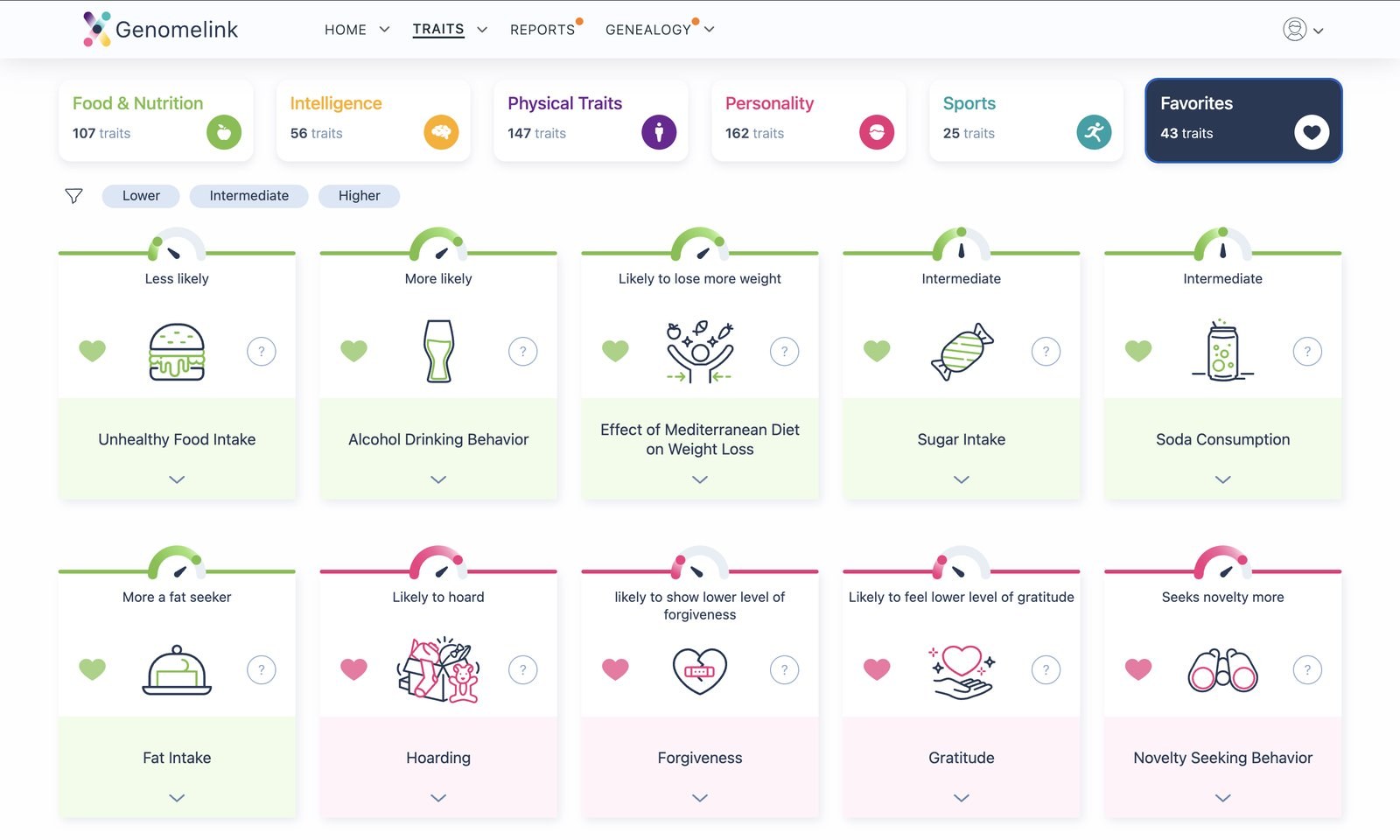
On the Traits side, I have 43 favorites saved. Some I recognized right away, like "Less likely" for Unhealthy Food Intake and "Seeks novelty more" for Novelty Seeking Behavior; a few made me laugh, like "Likely to hoard." The dashboard currently has 107 Food & Nutrition, 56 Intelligence, 147 Physical Traits, 162 Personality, and 25 Sports traits, and new ones are added every week.
DNA Matches showed 167 matches on the test date (Genomelink does not have many Japanese users, but we typically see thousands of matches for US and European users). The top entry is my own Ancestry kit (7,084 cM, "Self"), and after that, my closest matches are in the "6th Cousin or Beyond" range, sharing about 0.28% (19.84 cM). The match list pulls from Ancestry, 23andMe, and MyHeritage uploads, so each match shows which service their file came from. Users who have not shared their profile appear as "Incognito" animals, which is the privacy-first part I mentioned above. The new Lineage filter lets you tag which matches come through your mom or your dad.
Genomelink DNA Matches, "All matches 167"; name and location blurred
One more thing I want to show is a new YourRoots feature, the YourRoots Map. The screenshot below is not mine; it belongs to one of our users, who kindly gave permission to share it. Her family tree has 948 direct ancestors, and the map plots where they lived between 801 and 2000, color-coded by generation (9C to 20C). Next to it, you can see her Deep Ancestry ethnicity estimates: 20.3% and 18.5% in England and Wales, 12.4% and 8.7% farther north, 6.7% in the Netherlands and Germany, 3.9% in Ireland, 2.0% in southern France, and so on. What I find remarkable is how closely the two line up: the densest clusters of ancestor locations sit right on top of the regions with the highest percentages in her Deep Ancestry breakdown. Seeing your paper-trail genealogy and your DNA ethnicity estimate on the same map is what YourRoots is built for.
YourRoots Map: a user's family tree (948 members) plotted alongside her Deep Ancestry percentages, shared with permission
Things to be aware of
DNA Match is still smaller than GEDmatch (GEDmatch 1.5M vs Genomelink 1.1M), but it serves a different segment of users and places greater emphasis on a privacy-first matching experience and an easier-to-use interface.
Upload and the first 100+ traits are free with no credit card; the reports and subscriptions above are optional. You can delete your raw data and your account from the settings page at any time.
Verdict
A DNA upload site with a single mission: helping people maximize what they can learn from their DNA data. It maximizes the value of your DNA test by offering a wide range of analyses and experiences, from ancestry, ancient DNA, and genealogy to DNA matching and traits. I would say it's a must-try site if you've had your DNA tested somewhere (again, we are the ones building it). Unique ancestry analysis and traits are Genomelink's bread and butter; you won't find them anywhere else. It is a relatively newer player in genealogy, but a rising star, and a series of new YourRoots genealogy tools is being added.
GEDmatch
Tested on: October 2, 2026
Time to results: After upload, it went to "Processing" status. I checked the day after, and the results were available. GEDmatch says batch processing starts around midnight EST and takes about 7 hours, sometimes up to 2 days, and there is no email notification
The upload itself is simple: choose "Upload DNA Kit File," confirm that it is your own DNA (GEDmatch asks you to declare whose DNA it is), and pick a privacy option. Supported files are TXT, CSV, ZIP, or GZIP from Ancestry, 23andMe, MyHeritage, FamilyTreeDNA, and others. You get a kit number right away.
GEDmatch upload: the three privacy options, Opt In ("Most Popular"), Opt Out, Personal Research
What you get for free
One-to-Many
One-to-Many is the basic tool you will use the most. You can find the list of users who share cM with you, along with detailed metrics. It may be overwhelming at first, but once you get familiar with the genetic genealogy terms, you will find it very helpful. A few pieces of information to focus on:
Total cM: The total amount of DNA you share with the match, in centimorgans. It is the main signal for how close the relationship is: roughly 3,400 cM for a parent or child, ~2,500 for a full sibling, ~850 for a first cousin, ~200 for a second cousin, ~75 for a third cousin.
Largest: The longest single shared segment. A quick check that a match is real rather than noise; matches whose largest segment is under about 7 cM are often false positives, even if the total looks decent.
Source: Which testing company the match's file came from (Ancestry, 23andMe, MyHeritage, FTDNA, etc.). Useful because it tells you which company's database that person is in.
One thing you need to be aware of is that GEDmatch allows anyone to run DNA matches using a kit ID. So, when you see your One-to-Many results, you can click the kit ID of any of your matches and see what that match's own DNA match results look like. This is a very strong genetic genealogy tool that allows researchers to manually analyze each match and its shared matches, but it may leave some users uneasy, especially those new to the site.
GEDmatch One-to-Many Limited results in the new interface; emails and kit numbers blurred
One-to-One
GEDmatch recently updated its subscription plans, moving many One-to-One tools into the Tier 1 subscription. One-to-One Limited still allows you to compare your DNA with a selected match (you use the target match's kit number), and you can see on which segments of the chromosomes you share DNA.
GEDmatch One-to-One result showing shared segments on chromosomes 3 and 6
What you get if you pay
The Tier 1 subscription ($15/mo or $150/year) offers a variety of tools, like segment and triangulation tools and 2D and 3D chromosome browsers. According to the plan comparison page, the free plan includes 5 kit uploads, One-to-Many (limited) and One-to-One autosomal comparison, while Tier 1 adds unlimited kit uploads, multiple-kit analysis, Super-Kits, the advanced auto-cluster tools, and the Tier 1 utilities (Lazarus, Phasing, My Evil Twin). It covers a lot, so I will introduce the Tier 1 tools in a separate post.
GEDmatch Basic (Free) vs Tier 1 Membership, $15/month
My result
My One-to-Many list returned the maximum 50 matches that the free version shows (at the default 7 cM minimum). The top match was my own 23andMe kit, which I had uploaded years ago, at 3,567.8 cM, as you'd expect when you match against yourself. After that, my closest match shared only 28 cM, which is typical for someone with Japanese ancestry; most people in the GEDmatch database have European roots. Most of my matches came from 23andMe files, with a few from Ancestry and WeGene. I also ran One-to-One against one of them and observed shared segments on chromosomes 3 (7.3 cM) and 6 (7.5 cM).
Things to be aware of
The tool is designed for genealogists. GEDmatch itself describes the site as "a free DNA site built for genetic genealogy research" for "amateurs to professionals, genealogists, historians, researchers, and adoptees," so casual consumers might be overwhelmed and unable to use it effectively.
The site encourages you to opt in to a database that law enforcement can access for criminal investigations. If you do not want to participate, you need to opt out. At upload, "Opt In" is labeled "Most Popular," and the wording says your kit WILL be compared with kits submitted by law enforcement. "Opt Out" keeps you in matching for other users but not for law enforcement. "Personal Research" hides your kit from everyone else's match lists.
Tier 1 went up to $15/month for new subscribers on September 1, 2026, and free accounts are limited to 5 kits.
Verdict
The default place to find more matches across Ancestry, 23andMe, MyHeritage, and all other kinds of DNA tests. About 1.5M users have uploaded, according to GEDmatch. It has many genealogy tools that let you go deeper.
YFull
Tested on: October 7, 2026 (upload not accepted, see below)
A dedicated place to upload your whole-genome sequencing file to unlock unique Y-DNA/mtDNA analysis. Beyond the analysis, the site has been known as one of the most useful sources of Y-DNA trees, built on data accumulated over a decade of operation. Y-DNA analysis creates tree structures, and FamilyTreeDNA and YFull are the two main public Y-DNA trees that genetic genealogists cross-reference.
Things to be aware of
The site does not support uploading genotyping data from Ancestry, 23andMe, or MyHeritage. You need a BAM, FASTQ, or VCF file from a Big Y or whole-genome test.
In my case, my whole-genome sequencing VCF file was not compatible with YFull's upload, so I could not test it for this post. I will update this section with my CRAM data later.
Verdict
For people who already have a Big Y or whole-genome result and want to see exactly where they sit on the Y-DNA or mtDNA tree, with age estimates for each branch. If all you have is an Ancestry or 23andMe file, skip it for now.
MyTrueAncestry
Tested on: October 2, 2026
Time to results: About 1 hour (the site says "ready in 10 minutes")
The analysis summary shows your main ancient breakdown. MyTrueAncestry says this is calculated as follows: "Your DNA matches many ancient individuals from history. This chart shows your overall breakdown of Ancient DNA by civilization. This is based on your top matching civilizations and the classification of all your matching samples."
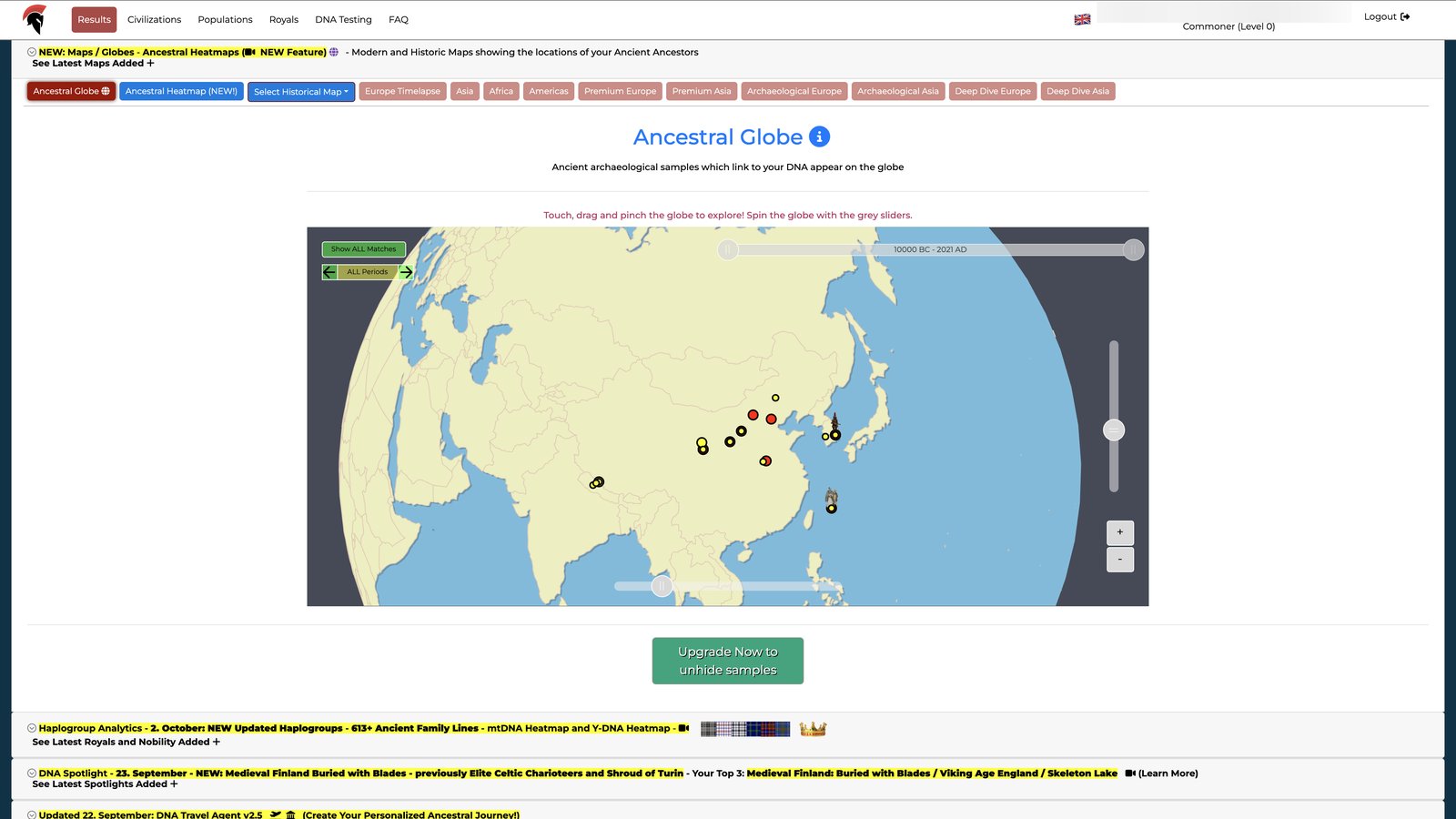
The free level ("Commoner") gives you 10 ancient samples with basic maps, timelines, and PCA charts, and the results expire in 48 hours. You also get a "Your DNA vs Ancient DNA" view for individual samples that shows the shared segments on each chromosome, and an Ancestral Globe that plots where your matching ancient samples were found.
MyTrueAncestry Ancestral Globe with sample locations in Japan, Korea, and China
What you get if you pay
MyTrueAncestry offers a lot of upgrade options, ranging from $37 (Level 1, "Footman") to $7,245 (Level 18, "Alexandria"), depending on the number of ancient DNA samples you can unlock (20 samples at Level 1, 3,750+ at Level 18), plus extras like deep-dive maps, themed reports, and "DNA castles". I do not recommend trying the expensive tiers immediately, but you may find it interesting to explore the site with a small upgrade.
MyTrueAncestry Level Comparison table, 18 levels
My result
This was my favorite result. "Your closest ancient populations…" says Tokugawa Shogunate, which makes sense: I am Japanese, and my closest ancient sample match would come from there. I wanted to dig deeper, like where I can find the original sample or how the data was obtained, but I could not find that on the site.
Other than Tokugawa, it shows some ancient histories like the Siba Culture or the Han Dynasty. It's a good way to learn about cultures and histories that might be associated with you. My full list was Tokugawa (distance 0.521), Licchavi Kingdom (1.226), Three Kingdoms of Korea (1.76), Siba Culture (1.978), and Han Dynasty (2.429); the smaller the distance, the closer the match. Each one comes with a short history lesson and a map, which is the part I enjoyed most.
MyTrueAncestry "Your closest Ancient populations…" with Tokugawa first
Things to be aware of
MyTrueAncestry does not necessarily show clearly where each ancient DNA sample comes from or how it is defined. Was it really from the DNA of a real Tokugawa-era person, or just ancient DNA obtained from that era?
Free results expire after 48 hours, so take screenshots. Coverage is deepest for Europe, and Asian coverage is growing. There are 18 paid levels, so take a moment to compare them before upgrading.
Verdict
Known as the site that started with ancient DNA analysis, even before other services offered similar insights. It has a wide coverage of ancient DNA and a unique experience you cannot find elsewhere. You can learn a lot about ancient cultures and history from your DNA data. Pricing varies widely, so I suggest starting with the free tier and minimal upgrades.
HaploMapper: a free Y-DNA and mtDNA haplogroup prediction from your autosomal file, mapped against ancient samples. Mine came back as Y-DNA D-Z1504 (a typical Japanese lineage, predicted from 1,114 verified Y SNPs) and mtDNA M7b1a1. It is honest about its limits: the mtDNA call carried a warning that coverage was sparse (only 7 derived hits) and should be treated as a best guess. It also listed exact ancient mtDNA matches, for example, samples from Balong Cave in Guangxi, China, dated 250–550 CE.
IllustrativeDNA HaploMapper with Y-DNA D-Z1504 and mtDNA M7b1a1
What you get if you pay
DeepAncestry (€29)
Periodical Breakdown: IllustrativeDNA says: "This section breaks down your ancestral DNA into specific historical periods, showing how different ancient populations contributed to your genetic makeup over time." The way they seem to do it is by combining multiple ancient DNA samples from the same region and era into reference panels, calculating which panels your genetic makeup is closest to, and presenting it as an ethnicity-estimate-like breakdown. You can step through four periods (Bronze Age, Iron Age, Late Antiquity, Middle Ages), and each result comes with a "genetic fit" score that tells you how well the model explains your DNA.
Closest Populations: IllustrativeDNA explains that each row is ranked by distance in a 25-dimensional ancestry space: the smaller the number, the closer your DNA sits to that population. Every row shows a population average, and you can expand it to see the individual ancient samples behind it.
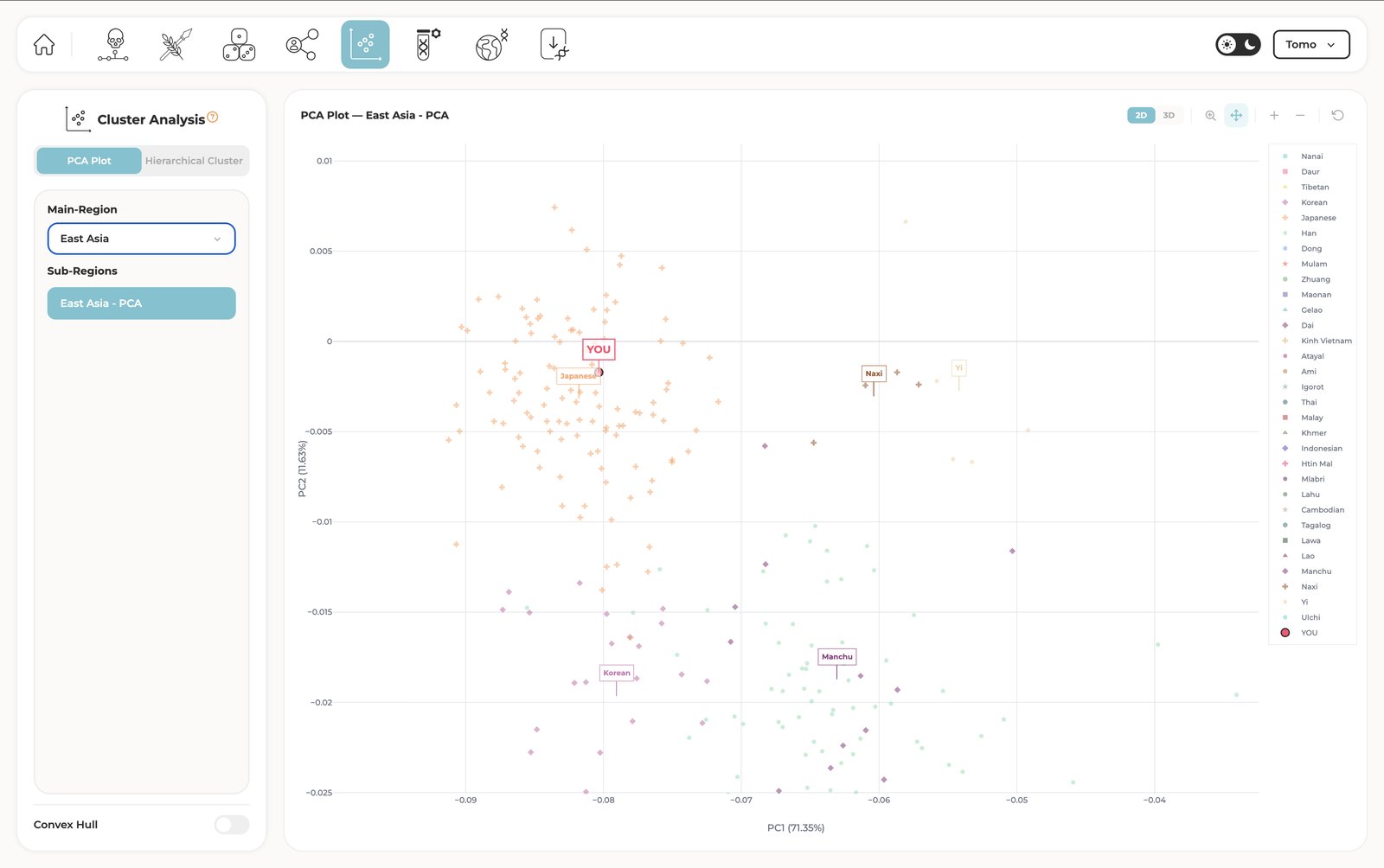
Cluster Analysis (PCA plot / hierarchical cluster): a PCA chart where you can see your dot among modern East Asian populations, and a tree view that groups you with the closest ancient populations.
AdmixLab (separate subscription)
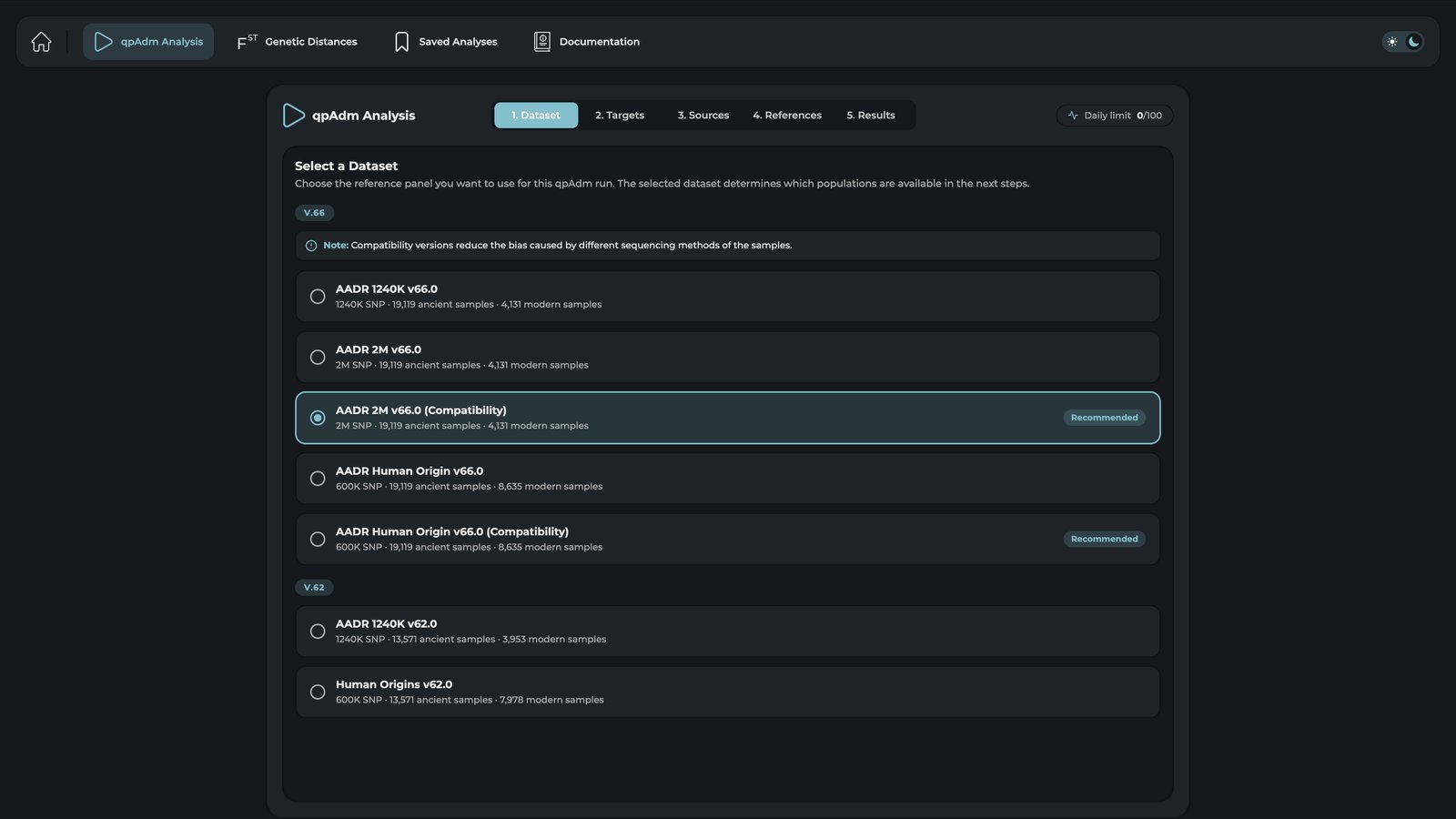
AdmixLab is a browser-based version of qpAdm, the academic tool (ADMIXTOOLS 2) used in population genetics papers, that runs on the AADR ancient-DNA reference panels. Nothing is precomputed: you pick a dataset, set your sample as the target, choose the ancient or modern "source" populations you think you descend from, and a set of "reference" populations, and run the model (5–10 minutes, up to 100 runs a day). A model is considered a good fit when the p-value is greater than 0.05, and all proportions fall between 0 and 1. IllustrativeDNA says it helps to have a basic understanding of population genetics and the ancient DNA literature. I looked at the wizard but did not run a full model for this post; the subscription price is shown after signup.
The Periodical Breakdown made sense to me. For the Bronze Age, it modeled me as 62.2% Yellow River (2300–1900 BC), 22.8% Amur River (1000–800 BC), 12.8% Jomon (6900–800 BC), and 2.2% Southeast Asian, with a genetic fit of 1.936 ("Good"). That matches the mainstream view of Japanese origins: mostly continental farmer ancestry from the Korean peninsula and China, with a minority Jomon hunter-gatherer component. For the Middle Ages, it simply says 83.4% Japanese (AD 540–1850) and 16.6% Sinitic.
IllustrativeDNA Bronze Age breakdown with the map
What I appreciated is that each population opens a card with a description, a list of reference sample IDs (for example, HJTM107, PLTM310), and a link to the research paper they came from. In Closest Populations, my #1 was Japanese (Kofun Period, AD 540–650) at a distance of 1.55, then Gaya Confederacy (Korea) at 3.99, Heishui Mohe at 6.09, Upper Xiajiadian Culture, Sinitic (Eastern Han), and Historical Ryukyuan. The PCA plot put my dot right on top of the modern Japanese cluster.
IllustrativeDNA Closest Populations list and map
IllustrativeDNA PCA plot, East Asia, with "YOU" next to Japanese
Things to be aware of
IllustrativeDNA is a small team registered in Estonia (founded 2021), and pricing is shown after you sign up. MyHeritage built its "Ancient Origins" feature, launched in February 2025, in partnership with IllustrativeDNA, which says a lot about how the engine is regarded. The results are models that can change as the reference data improves, so read the percentages as models rather than facts, and only upload through the official site.
Verdict
For €29 you get a very transparent ancient-ancestry report, with the actual samples and papers behind every number, and a free haplogroup prediction on top. Recommended if you want to understand how the ancient DNA models work, not only what they say.
Genetic Genie is simple to use. There is no account; you pick a panel (Methylation, Detox, or the GenVue Discovery variant report), upload your file, and the result is on the screen in seconds. It accepts 23andMe, AncestryDNA, MyHeritage, FTDNA, LivingDNA, and WGS/WES VCF files, and says your data is deleted after processing.
Genetic Genie homepage, "Genome tools accessible for everyone"
What you get for free
First off, I should explain the terms heterozygous and homozygous. Genetic Genie reports results for both, and you need to understand how to interpret each.
You have two copies of every gene, one from each parent. Heterozygous means one copy carries the variant; homozygous means both do. For most of the panels Genetic Genie shows, homozygous is flagged as the stronger finding, and a heterozygous result often has little or no effect on its own. Also: ClinVar's "pathogenic" or "risk factor" label describes the variant in the literature, not a diagnosis for you; "risk factor" variants for polygenic conditions move the odds somewhat; they do not mean you have or will get the condition. In the GenVue report, heterozygous variants are shown in yellow and homozygous variants in red.
Genetic conditions
My result identified some pathogenic variants, such as "Age-related macular degeneration 4, polygenic." It was labeled as clinically significant and a pathogenic risk factor, so I did some follow-up research. "Age-related macular degeneration 4" (ARMD4) in ClinVar refers to a risk variant in the CFH gene region (most often rs1061170, the Y402H variant). It is one of the best-studied common risk factors for AMD: carrying one copy raises lifetime risk roughly 2–3×, two copies more, but most carriers never develop AMD, and age, smoking, and diet matter as much. ClinVar labels it "risk factor," not "pathogenic" in the Mendelian sense. In my case, it is heterozygous (one copy), with a reference allele frequency of about 27%, so it is a common variant. The report also links to the same entry on LitVar, SNPedia, dbSNP, OMIM, and 301 PubMed papers, which is where the real reading starts.
It returns many drug responses I am interested in, with tags such as "Expert Reviewed" (mostly from ClinVar data). Two examples from my report: GSTP1 (rs1695), heterozygous, which ClinVar links to toxicity and efficacy of several chemotherapy drugs (platinum compounds, cisplatin, fluorouracil), and COMT V158M (rs4680), where I am homozygous (AA). Genetic Genie's note describes COMT V158M as "a codominant allele affecting COMT enzyme activity, considered a benign functional polymorphism," with the well-known "worrier vs. warrior" claims about memory and attention. It is the kind of variant you will see discussed in many wellness blogs; the report gives you the raw facts and the links, and leaves the interpretation to you.
Genetic Genie GenVue Drug Response tab, GSTP1 and COMT entries
Rare mutations
Here I found some interesting information. I seem to be a carrier of the rare variant rs34594498, which might be related to Parkinson's disease. But it also flags an attached comment citing other researchers who point out the limitations of the source research. The entry comes from a GeneReviews submission to ClinVar, and the curation note says that a 2006 study (Di Fonzo et al.) found the variant at equal frequency in cases and controls, and that according to ExAC about 1 in 90 East Asians carry it, so "this reported effect should be considered disproven." rs34594498 is, as far as I can tell, LRRK2 p.Ala419Val, an East Asian-specific risk variant with modest odds. I do not draw any health conclusions from this, but it is interesting to see what I have and what researchers are discussing about the variant.
Genetic Genie GenVue Rare Mutations tab, LRRK2 rs34594498 with the curation note
Methylation panel
Methylation analysis has been popular in the wellness world for years, and it reached a much bigger audience when Gary Brecka talked about the MTHFR gene and methylation on The Joe Rogan Experience (episode #2060, November 2023), telling listeners to avoid folic acid and take methylfolate instead. Genetic Genie offers the analysis. It provides a comprehensive analysis of methylation-related variants (MTHFR, MTR, MTRR, COMT, CBS, and others), along with an explanation of what each variant means for you.
My panel came back mostly green. The two MTHFR variants everyone asks about, C677T and A1298C, were both normal for me. These two get the most attention because they reduce the activity of the MTHFR enzyme, which converts folate into its active form (methylfolate). When one of them is detected, especially two copies of C677T, the usual advice in wellness circles is to take methylfolate instead of folic acid, eat more leafy greens, and check your homocysteine level with a blood test. Mainstream medical guidelines do not recommend routine MTHFR testing, so treat it as a conversation starter with your doctor rather than a diagnosis. The homozygous (red) ones were COMT V158M, VDR Taq, MAO-A R297R, and ACAT1-02, and a handful were heterozygous (MTRR, BHMT). Genetic Genie also lists the variants it could not find in my Ancestry file (BHMT-08, AHCY-01, AHCY-02, and others), which is a good reminder that each chip covers a different set of SNPs.
Genetic Genie Methylation Panel table with red/yellow/green results
Detox panel
The detox panel covers the genes that process caffeine, alcohol, medications, and environmental toxins: the CYP family (CYP1A1, CYP1A2, CYP1B1, CYP2D6, CYP2E1, CYP3A4), GSTP1, SOD2, and NAT1/NAT2. People mostly use it to check how they metabolize caffeine (CYP1A2 is the one that gets quoted) or to explain why a medication feels stronger or weaker for them, and some practitioners use it to argue for supplement protocols. In my case, most genes came back normal; the heterozygous ones included CYP1A2 164A>C, CYP1B1 L432V, CYP2D6, GSTP1, and NAT2 R197Q. Nothing homozygous. Again, this is information to be curious about, not something to act on without a professional.
Genetic Genie Detox Panel table
Things to be aware of
Newer chips (23andMe v5, Ancestry v2) cover fewer of these SNPs, so some panels come back partial. In my case, the methylation panel listed several variants "not found in your file."
It is not consumer-friendly, and Genetic Genie does not claim to be: the site says its tools are "designed to be accessible to citizen scientists, professional researchers as well as research physicians," and it calls GenVue Discovery a "research tool." You need to understand what ClinVar says about each variant.
Verdict
Free access to clinical variants, mostly from ClinVar. It might not be friendly enough for consumers; you need to understand what ClinVar says about each variant. It is also a free way to check a methylation panel and get instant results. The explanation may not be as simple as other methylation DNA tests, but you should be able to interpret it on your own.
Before you can upload, Promethease asks you to tick nine statements, including that the report is for educational and research purposes only, that it is emailed to you and not stored on their servers, and that you accept the risk of learning you may be at high risk for a debilitating disease. It is a good summary of what you are getting into.
Promethease agreement checklist before upload
What you get
You receive the results by email and download a zip file. Unzip it and open it as an HTML report. It's based on SNPedia, a Wikipedia of SNPs, primarily focused on genome-wide association study (GWAS) results that indicate genetic associations with certain conditions. My report covered 59,060 genotypes from my Ancestry file, with a "highest magnitude" of 4.0 (magnitude is SNPedia's 0–10 scale of how interesting a variant is).
Promethease report email, 59,060 genotypes
Promethease default "Bad" view with gs122 and rs738409(C;C)
The default view shows "Bad" results, meaning something was reported. In my case, the top one was a 7× risk of male baldness. (I knew it from my Genomelink result, from my grandparents, and apparently from myself.) This one (gs122) comes from a 2008 Nature Genetics study: one man in seven who carries risk alleles at both the 20p11 locus and the androgen receptor gene has about a sevenfold increase in odds of androgenic alopecia.
I also received a higher risk of alcoholic liver disease, with the variant rs738409 (C;C), which means I carry two copies of the PNPLA3 risk allele. It is hard to draw any health conclusions from these results, but it is a good reminder to be aware of these conditions.
The link takes you to SNPedia, where you can learn more about the variant. There, I could find the original study (https://pubmed.ncbi.nlm.nih.gov/19946271/) from 2010, which conducted a GWAS and discovered the association with alcoholic liver disease. SNPedia itself warns that the literature is confusing on this SNP because most papers report the opposite strand, which is a good example of why Promethease needs careful reading.
I also filtered results for diabetes. It then shows "Bad" and "diabetes" results together. Some variants indicate a 1.x× increase in risk of diabetes. These are mostly from GWAS studies. The top one for me was rs7754840 (C;G) in the CDKAL1 gene, a 1.3× increased risk for type-2 diabetes. What I liked is that SNPedia lists the follow-up studies, including one that replicated the finding in 1,900 Japanese patients (odds ratio 1.28), so I could see that this one actually applies to people like me.
Promethease report filtered by "diabetes"
Things to be aware of
You can filter and search for what you are interested in, but it requires a certain level of understanding of how this information works. Promethease describes itself as "a literature retrieval system" used by "biomedical researchers, healthcare practitioners and customers of DNA testing services," and the first box you tick says the report is "for educational and research purposes only."
The report costs $25 (many older articles still say $12–15), it is emailed to you and deleted from Promethease's server after 45 days, and Promethease has been owned by MyHeritage since 2019.
Verdict
Promethease is a very affordable way to see what the published studies say about your own variants. It is a research tool: it does not tell you what to do, it shows you which papers to read. If you are curious and willing to click through to SNPedia and PubMed, $25 is well spent.
DNA tests that accept DNA upload
FamilyTreeDNA
Tested on: October 2, 2026
Time to results: Within a day for Family Finder (DNA matches)
The upload accepts .zip or .csv files up to 50 MB; my Ancestry file went through without a problem. Before you see matches, you have to agree to the DNA Matching Consent, which explains that your matches can see your name, email, haplogroups, ancestral surnames, and public tree.
What you get for free
Family Finder matches
You can find basic DNA matches for free, like on other DNA testing and upload sites. The unique feature is that FamilyTreeDNA shows the haplogroup (Y-DNA and mtDNA) for each match. So when your match took FamilyTreeDNA's Y-DNA or mtDNA test, the match will show the haplogroup, and you can find matches who share the same group or branch. This is unique to FamilyTreeDNA.
Family tree
Currently, FamilyTreeDNA partners with MyHeritage to manage your tree. So you can connect your existing tree on MyHeritage, or create a new one on MyHeritage and then connect it.
FamilyTreeDNA dashboard after transfer: Family Finder Matches and Matrix open, myOrigins / Chromosome Browser / Chromosome Painter / ancientOrigins locked; kit number blurred
What you get if you pay
In 2026, FamilyTreeDNA changed how it handles upgrades for autosomal transfer users. It asks you to pay $29 to access tools like myOrigins, ancientOrigins, Chromosome Painter, and the chromosome browser, but this upgrade has two conditions. You get access to these tools if your transferred data is "sufficient"; if it is not, the purchase is converted to a new DNA test kit from FamilyTreeDNA (next-generation sequencing). See the checkout card message in the screenshot. The checkout note reads: "Upgrades are processed on the DNA sample that was originally submitted. A new collection kit will be mailed only if that sample is insufficient." With a transfer, there is no sample on file, so in practice, it means a kit. The total was $38.95, including $9.95 for standard shipping.
FamilyTreeDNA checkout, $29 + $9.95 shipping; address and kit number blurred
My result
In my case, I was expecting an instant unlock to access the other ethnicity analyses, but it turned out that my upgrade purchase was converted to a new test kit, and my account status changed to waiting for the new kit to be shipped.
I had 108 Family Finder matches on the test date. The top two were my own earlier kit and a close family member who had tested with FamilyTreeDNA (parent/child, 3,524 cM); after that, my closest match was in the 3rd–5th cousin range at 47 cM. The list is short for someone with Japanese roots, but these are people who tested with FamilyTreeDNA, so they do not appear anywhere else.
FamilyTreeDNA Family Finder match list, "All (108)"; names and kit number blurred
Things to be aware of
The Y-DNA and mtDNA reports are only available to those who take FamilyTreeDNA's own tests (the Y-DNA tests, such as Y-37 and Big Y-700, and the mtDNA test).
Be aware that, as of now, FamilyTreeDNA is mostly encouraging you to take the new next-generation sequencing test as the autosomal transfer upgrade.
FamilyTreeDNA's help page lists 23andMe (v3–v5), AncestryDNA files from before October 2025, and MyHeritage array files from before October 2025 as accepted. My Ancestry file (V2.0 array, generated November 4, 2025) was accepted without a problem, so it is worth trying even if your file is newer.
Verdict
If you want to maximize your chances of finding more DNA relatives, uploading to FamilyTreeDNA can expand your chances of finding more matches, so you should.
Sequencing.com
Tested on: October 7, 2026
Time to results: Uploaded on October 7; as of October 14, the free report had not arrived
I tried the Next-Gen Disease Screen (free). A week after the upload, the report had still not arrived, so I cannot show the result. I will update this section if it arrives.
What you get if you pay
Upgrades are available by buying premium reports from Sequencing.com, or by buying individual reports from their Apps and Reports marketplace. Sequencing.com partners with a variety of DNA companies, including Golden Gate Gene, SelfDecode, GenoPalate, Seeking Health, and Complete Genome Science. You can buy their reports from Sequencing.com and access them there. On the Health tab, for example, SelfDecode's MTHFR DNA Wellness Report is $29, its Gut Health and Methylation Pathway reports are $59, Seeking Health's StrateGene is $95, and the Medications PGx guide is $129.
Sequencing.com Partner Marketplace, Health tab
My result
Not available. The free report had not arrived as of October 14.
Things to be aware of
Sequencing.com's main focus today is selling a whole-genome sequencing test kit that can "Assess your genetic risk for 15,000+ diseases, conditions, and traits with actionable insights."
Verdict
DNA upload is a freemium way to try their health analysis and access other partners' analyses without leaving the platform.
LivingDNA
Tested on: October 2, 2026
Time to results: Uploaded at 4:42 pm; the free Recent Ancestry result was ready the same day, and Family Matching showed "Pending" at first and was ready when I checked again on October 7
LivingDNA dashboard for a "Digital upload" profile: Recent Ancestry Taster and Wellbeing Taster free, everything else "Not added"; profile ID blurred
What you get for free
Recent Ancestry: you need an upgrade to access the deeper breakdowns. The free "taster" shows a continental-level breakdown with a map; the regional and sub-regional view (the part LivingDNA is known for) is behind the Autosomal Upgrade (£25).
Family Matching: shows unique matches who took DNA tests with LivingDNA or uploaded to it.
Some free traits, such as Vitamin D and Maximum Strength. The rest of the nutrition and fitness traits (Vitamin C, B12, Omega-3, lactose tolerance, endurance, recovery speed, and so on) are shown but locked.
What you get if you pay
Autosomal Upgrade (£25): unlocks the regional and sub-regional ancestry breakdown for uploaded data. This is the one I bought.
Digital upgrades: Bakers (£10), Classical (£25), Neanderthal and Denisovan (£20), Viking
LivingDNA Store, Digital Upgrades: Bakers £10, Classical £25, Neanderthal and Denisovan £20
My result
My free results indicate 96%+ Japanese and Korean. To be exact: 96.6% Asia (East), with "Japan and Korea" at 80–100%, plus 2% Native Americas (Mesoamerica) and 1.4% Europe. The 2% Native American is already visible in the free continental view; I have not seen it from any other service, so I read it as an estimate at the edge of the model rather than a real ancestor.
LivingDNA Recent Ancestry results, 96.6% Asia (East)
Family Matching found a handful of "4th cousin or greater" matches, the closest sharing 0.48% (34.74 cM) over 6 segments. All of them had Japanese names, which tells you who is in LivingDNA's upload pool.
Things to be aware of
LivingDNA does not provide Y-DNA/mtDNA haplogroup analysis for uploaded autosomal DNA data, but you can purchase their test kit, which covers both.
Matching is not instant; mine was "Pending" on the day of upload.
Verdict
One of the most popular DNA tests in the UK, with a detailed UK breakdown built on a unique dataset they have created. If you have strong family roots going back to England, which is true for many American users too, it is highly recommended. It will also give you unique DNA matches from their UK user base. If you want to maximize your chances of finding more DNA matches, make sure to upload.
Other sites to check
DNA Painter
Time to results: Instant
Cost: Free, or a subscription ($55/year for up to 50 maps and trees)
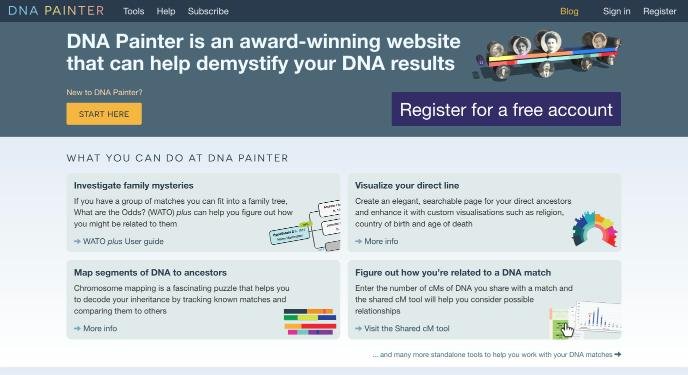
DNA Painter is a popular genetic genealogy tool site, especially known for its chromosome painter and WATO tools. You do not upload raw DNA test data; instead, you copy and paste DNA match information from each test for analysis.
DNA Painter homepage, "What you can do at DNA Painter"
For example, DNA Painter allows you to copy and paste shared cM data from DNA match results on 23andMe, MyHeritage, GEDmatch, and LivingDNA and show them on a unique chromosome canvas. It helps you visually understand which segments of your DNA might be shared from a cluster of common ancestors.
Also, the WATO (What Are The Odds) tool helps you understand how to place your DNA matches from each service into your real family tree. It helps you systematically understand the probability of each placement.
The free account gives you one chromosome map, one tree, and one WATO Plus project, plus all the standalone tools like the Shared cM tool. The subscription unlocks multiple maps and trees, as well as bulk import.
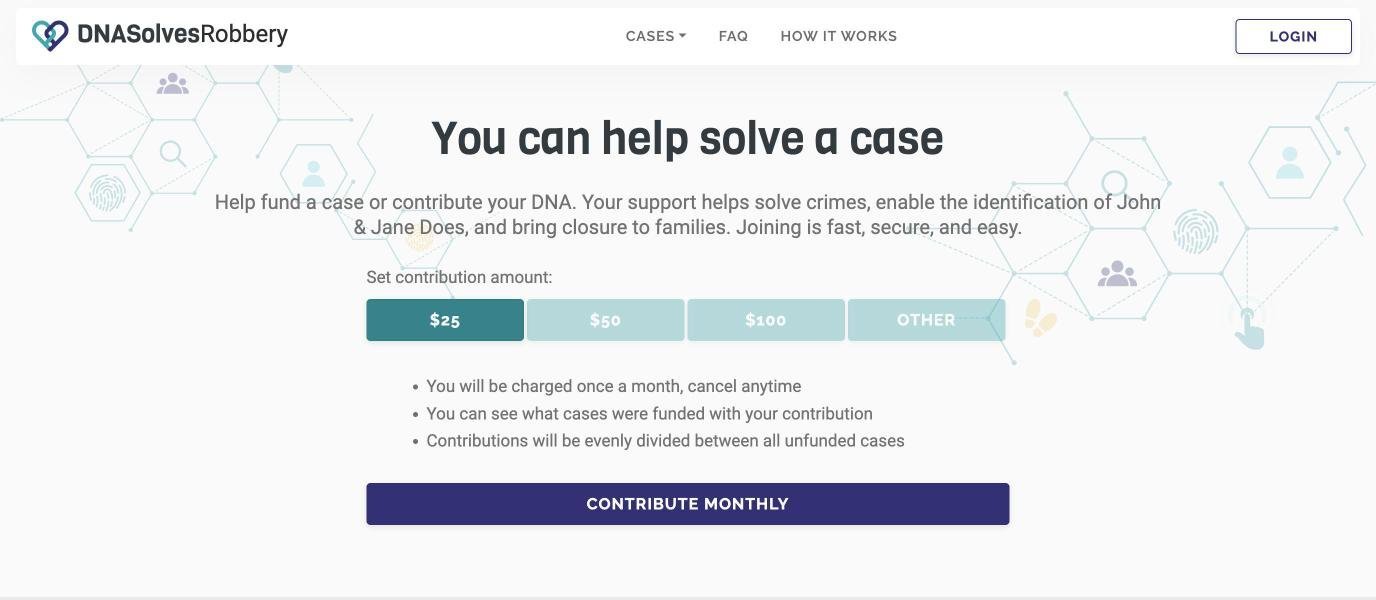
DNASolves is a site where you can contribute your DNA data to a forensic genomics project. You can find a list of active projects and donate as well. The company behind it, Othram, is one of the leading forensic genomics companies, and DNASolves is a place where you can support their projects. The homepage asks for a monthly contribution ($25, $50, or $100) to fund cases, and you can also upload your DNA to help identify unidentified remains. You do not get a report back; it is a way to contribute your data to their work.
DNASolves homepage, "You can help solve a case"
Speaking of the law enforcement relationship, a few things to clarify for your consideration:
DNASolves is an independent website that specifically recruits users who want to contribute DNA data to forensic projects.
FamilyTreeDNA and GEDmatch are consumer services that are also publicly known to work with law enforcement, and you are asked to opt in or out of allowing the company to include your data in the database used for that. So it is part of their business model.
Major DNA testing companies like Ancestry and 23andMe usually publish their law enforcement policies (as does Genomelink) to disclose their engagement. Usually, they do not proactively engage in law enforcement projects as part of their business model, and they require a court order when necessary.
FAQ
Is it safe?
I would say the sites I used and introduced here are relatively safe. They have real product traffic and have long been trusted by many DNA test users. But there are newer sites whose owners I cannot verify, and some have unclear terms. So if you try a site not listed here, I suggest checking reviews and the terms of use before uploading, and keeping your own copy of your raw data file.
Which file do I upload?
You upload the raw DNA data file you downloaded from your testing service, usually a .txt or .zip file (some sites also accept .csv). Major DNA test services like Ancestry, 23andMe, and MyHeritage provide clear instructions for downloading it (see below), and you can upload that file as is.
Usually yes. Most sites let you delete your raw data or your account from the settings page. If you do not see the option, contact support or use the site's privacy request page to submit a data deletion request.
Do they sell data?
It depends on how you define "sell." Many of these sites use marketing tracking tools like the Meta or Google Pixel, and they usually comply with each country's or state's requirements by showing a cookie banner or asking for your permission before sharing data with the ad platform.
Some services, like GEDmatch and FamilyTreeDNA, work proactively with law enforcement, but only with your explicit opt-in. Read the privacy policy before you upload; every site introduced here has one.
What if my kit isn't supported?
I would suggest contacting the site's support. Each site may have file format restrictions for security or compatibility reasons. But DNA data formats are fairly standard, so your file can usually be supported. It is also worth double-checking that you downloaded the raw data file and not a different export, such as a match list or a PDF report.
How this was made
I visited each site between October 1 and October 14, 2026, as part of my own product research. I uploaded the same Ancestry raw DNA data file to each one, took screenshots of my own results, and made notes on what each site does, what my results looked like, and what I liked. Prices and Semrush traffic figures were recorded during the same period, and I will update the sections that are still pending as results arrive.
Tomo founded Genomelink in 2017 in San Francisco and has over a decade of experience in consumer and medical genomics. Before Genomelink, he was a business producer in the genomics business group at M3, Inc., where he led the building of a precision medicine network in Japan. Genomelink has been part of Illumina Accelerator, Berkeley SkyDeck (UC Berkeley), StartX (Stanford), and Y Combinator (S21). He tests DNA upload sites, genealogy tools, and ancestry reports with his own raw data file and writes up what he finds.
Get the most value from your DNA test results
Have you got DNA tested from Ancestry, 23andMe, or MyHeritage? Get free DNA analysis on Ancestry & Traits. Find more DNA matches & family trees.